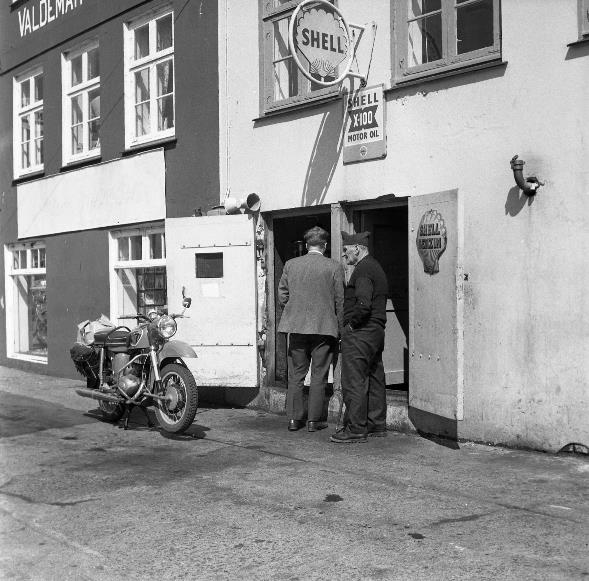
When Bryggjubakki united Tórshavn’s Labourers

The distinctive and colourful concrete buildings in Bryggjubakki have played a key part in Tórshavn’s rise to the bustling and creative scene/city/community it is today. Among the earliest organisations working within these iconic walls was the Faroese Labourers’ Union. That was in 1927-1935 when today’s prosperity would have seemed unimaginable.  

If houses could speak, they would tell countless interesting stories of how a society has changed over the years. This is certainly the case in Bryggjubakki, where the concrete houses have been standing proudly since 1927.

These buildings have housed a wide variety of businesses and organisations over the years, including Poul Hansen Heilsøla. The letters remain clearly printed on the creamy yellow buildings, although the wholesaler moved into new facilities outside the city centre decades ago.

Another organisation operating in these buildings from the start was the Tórshavn Labourers’ Union, which remained in the building until 1935 – when times were much harder than today.

Tórshavn in those days was a far cry from the modern city we have now.

In the early 1920s it became clear that a concrete wharf needed to be constructed to improve landing conditions for boats and to guard against the heavy surf which often plagued the Vágsbotnur marina, where The Tarv is now located.

Construction began on the first part of the wharf in 1922. It was to stretch all the way out to Tinganes, the historic location of the Faroese government.

As soon as work began, a heated dispute over wages started between the local labourers and the Danish construction firm. The labourers also complained that men came in from other villages to work on this project, because there wasn’t enough work for the workers from Tórshavn.

Tough times

The concrete wharf was completed in 1929 – the same year the Wall Street crash sparked a global financial crisis. Tórshavn’s labourers were also affected by this crisis, and the authorities levied distress on many of their goods as they struggled to pay their taxes.

The local labourers were hoping to earn some money doing dock work for Danish and Faroese shipping companies. However, this work usually ended up being done by the ships’ crews. The locals protested against this, saying that they – and not the ship crews – had the right to work on the wharf.

In 1933, the Tórshavn Labourers’ Union set out to assess how its members were doing. It turned out that their situation was miserable. Out of the 500 union members, 340 were unemployed and fewer than 100 were in full-time employment. So it is understandable that the labourers went out of their way to obtain available jobs and push for the creation of new jobs.

Pressed for space

With all these desperate workers gathering in the union’s community rooms, space became increasingly problematic as most of the building had been rented out to tradeswoman Hansina Johannesen, who ran a shop there. By 1935 the problem had become unbearable and the union ended up selling the entire premises to Johannesen for DKK 13,500.

Shipping company J. P. Evensen & Søn had just gone bankrupt at that time, and the Labourers’ Union was offered Evensen’s warehouse for DKK 25,000 (kanska goyma hetta til myndatekst). The union spent the next few decades there before moving into its current offices on Tinghúsvegur.

Today there are not many, if any, signs of these past struggles in Bryggjubakki and the surrounding Vágsbotnur marine area. This is now one of the city’s most stylish spots, with hordes of locals and tourists enjoying the seemingly ever-increasing number of trendy cafés and restaurants.

THE TARV is proud to be the latest addition to this impressive transformation of Bryggjubakki and Vágsbotnur.

Sources:  ‘Til arbeiðis! Lív ella deyð!’, Helgi Eidesgaard, 2017. ‘Stríðsmenn í Havn’, Uni Arge and Hans Petur Hansen, 2017.

Written by Uni Arge. Translated by prosa.fo

The birthplace of Faroese radio

The National Faroese Radio (ÚF) had its first live broadcast on 6 February 1957 in the building

The new radio station had a humble start, with only a few hours of broadcasting per day due to limited staff and funding.

As a possible candidate for the title of world’s smallest national radio station, the staff consisted of only four people in the first few years.

The building (((myndir innan og uttan))) wasn’t exactly huge either, but just big enough for a couple of offices, a small studio and a modest record collection.

The central location, however, made up for many of these limitations. Lots of people dropped in from the street, which was great for the curious journalists, who were always on the lookout for the latest news and gossip.

Neighbours at the time included the Fishermen’s Association, Tórshavn’s Labourers’ Association and several restaurants. There was also a great deal of boat traffic and fish trading on the quay. All this activity created a vibrant atmosphere which inspired the creativity of the ÚF staff.

Although ÚF’s ambitions constantly exceeded its resources, the station not only broadcast news but it also managed to produce quality radio plays, many of which have now become timeless classics. The station also formed a radio choir, which has played a crucial role in keeping the rich Faroese song tradition alive.

In 1969, the V4 radio lottery was established as a means of strengthening the station’s finances. The V4 programmes, featuring songs and satire, became more popular than anyone had imagined, and the financial rewards soon became clear.

Along with this significant financial boost came an increase in staff and ambitions, and the limited space in Bryggjubakki building became increasingly problematic.

Preparations began on a new, much larger and modern building in the northwestern part of the city. The new building was completed in 1982, just in time for ÚF to move in on its 25th anniversary.

Gone were the happy yet stressful days in Bryggjubakki, but the new building gave rise to further developments, including the establishment of a TV station, which in 2005 merged with ÚF to form Kringvarp Føroya, the Faroese Broadcasting Corporation.

Text: Uni Arge. Translation: Prosa.fo

It all started with the first Faroese street café license

Enjoying a glass of beer outside Faroese drinking establishments was illegal until 2008.

A major change in Faroese culture occurred when café/bar hvonn decided to implement a smoking ban – long before the national ban on smoking in public places came into force.

Needless to say, this didn’t go down well with the smokers. so hvonn wanted to allow them to bring their pints outside when they went for a smoke. The café/bar was eventually given this license, and the now popular white passage outside the bar came into being.

In 2008, the first beers were served outside a bar with permission from the authorities. This historic occasion took place just across the road from hvonn, at Café Vágsbotn, an offshoot from hvonn. After some mediation with the authorities the café was given a ‘summer bar’ license in the old petrol station building where THE TARV opened xxx years later.

The summer that changed Ólavsøka

Café Vágsbotn enjoyed a good start. The Ólavsøka national festival took on an entirely new turn thanks to a group of accordion players who set up an impromptu session outside the café.

For decades, maybe even centuries, Áarvegur and the area around the City Hall (the stony building next to the red hvonn/Hotel Tórshavn building) had been the focal point of the Ólavsøka celebrations, with big crowds of people gathering there.

This all changed suddenly in 2008 when the lively accordion music drew the crowds down towards the Vágsbotnur marina. Here, they were met with a refreshingly different atmosphere and, for the first time ever, they were allowed enjoy the sunny weather with a cold beer fresh from the tap on Café Vágsbotn’s front terrace.

The rest, as they say, is history.

Since then, the Ólavsøka festivities have seen a fundamental transformation as the marine suddenly became the pulsating heart of the city centre, with a surge of outdoor cafés, the fish market and the large stone steps structure leading down to the marina.

THE TARV (Faroese for ‘The Bull’) is now taking this development one step further. It is not aiming to compete with the other charming outlets in the area such as Kaffihúsið, Umami, hvonn, Sirkus and Glitnir. As the only high-end grill house in the area/city/country THE TARV is a different animal altogether. We’re really excited to welcome everyone – locals, visitors and Michelin judges – to enjoy the unforgettable experience of tasting our grilled masterpieces in our charismatic new restaurant.

Written by Ingi Samuelsen. Translated by prosa.fo